- Welcome to the North Meadows
- North Meadows Philosophy
- Management
- Identifying Flowers in the Meadow
- Native Grasses
- Native Plants
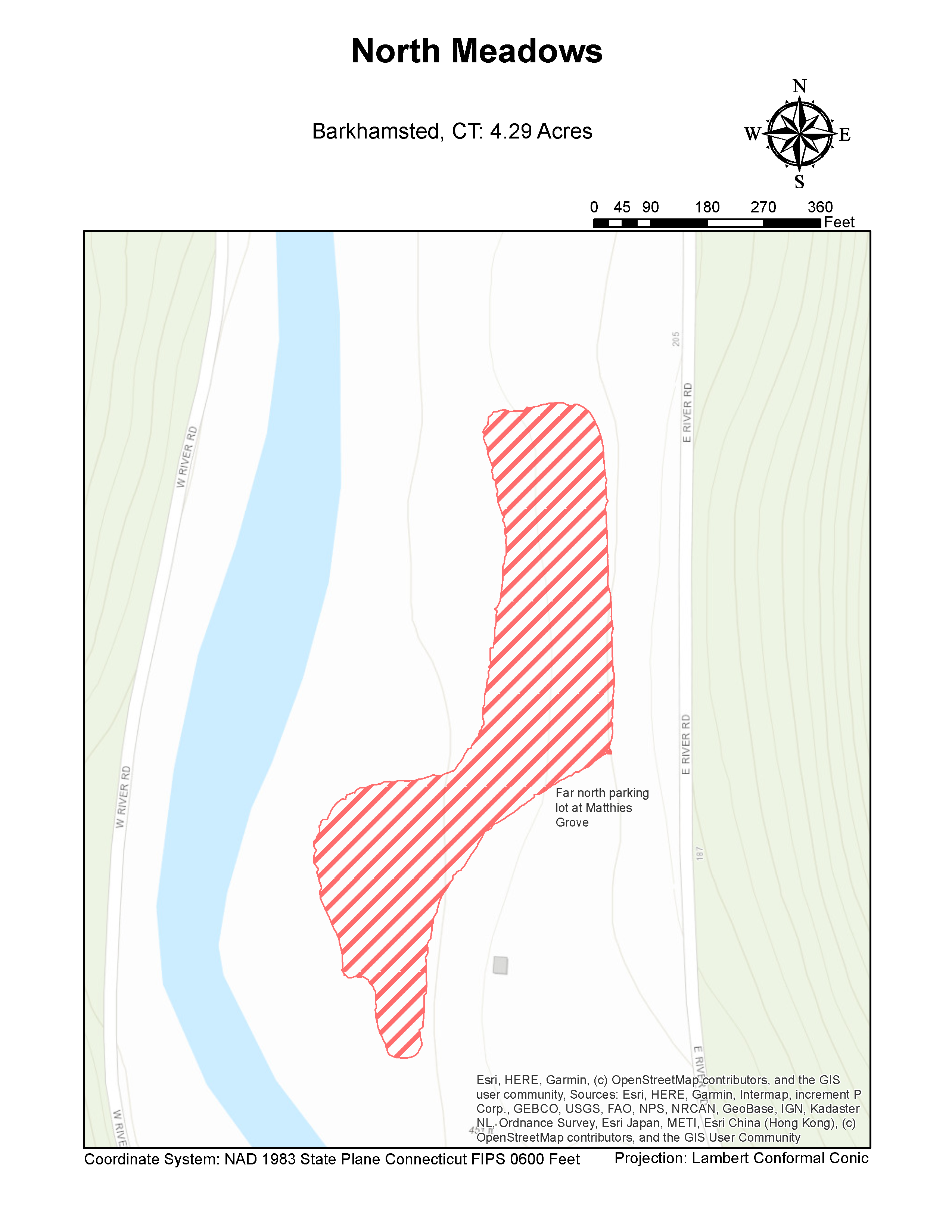
Welcome to the North Meadows – MAP
Please contact Dave Lewis with questions or comments: lewisd1691@gmail.com
Our meadows are managed and protected to encourage wildlife and pollinators. Adding plant and wildflower species for diversity, removing invasive plants, monitoring, and establishing practices to improve the health of the meadow are all part of its development. Without these actions, the state of the meadow will deteriorate, invasive plants will increase, and species of desirable plants and wildlife will become less diverse.
Here you can find information on meadows, how we are managing them, and what you might find in them. A Wildflower Identification Guide is currently being developed, which will list the plants you will find there. The guide as well as other informational content will be added frequently, so check back for updates.
Our meadow has amazing potential. There are many plants present now that are native and important to wildlife and pollinators, some with remarkable characteristics, and some which are not usually seen. Some of the grasses are the same species which once covered our nation’s mid-section forming the great prairie. We continue to add new species of wildflowers and build a shrub border around the meadows to provide cover and food for migratory birds and insects.
We are advocates for an ever-evolving natural landscape which changes from season to season and year to year, always showing the beauty of a natural meadow, while promoting recreation, education, and the interest of visitors.

A meadow is:
A place for pollinators to pollinate
A space for wildflowers to grow
An area to help our native plants flourish
A food source for birds, insects, and other animals
A great place to visit or walk with the whole family
North Meadows Philosophy
All meadows are temporary. They are always changing and ever being redefined and reshaped by weather, climate, invasives, the encroachment of shrubs, trees, and especially by human development. Just as meadows can hold an incredible diversity of plants and wildlife, they exist in many types, differing widely in what can and can’t grow and live within them. Meadows are not all created the same; some are leftovers from cattle pastures, some former lawns that have been left to overgrow, and some are vestiges of another time- a puddle left over from the great tall grass prairie oceans that once covered much of our country’s middle section. These important differences determine the means by which a particular meadow can be successfully maintained.
To fully understand our meadow and consider improvements, it is necessary to know what kind of soil lies beneath, how wet or dry it is in different seasons, what kind of plants and animals are presently there, and what may threaten its overall health. Only then can we plan for what kinds of new plants to introduce, what to remove, and what wildlife can be attracted and supported. Only when we know where we are headed, will we know when we have arrived.
Wildlife conservation is the preservation and protection of animals, plants, and their habits. To ensure support for preservation, it is essential for people to have access to the meadow. To protect wildlife, humans need to understand the relationships between species and their habitat, and their own role in promoting community support for conservation. Building upon public support for the ecology of the site depends upon people visiting the meadow, and it is vital to educate them about meadows and how they work. In this way, we can build upon an appreciation of this unique site and foster considerate and responsible behavior towards the plants and animals of the meadow.
Just as a meadow is always a work in progress, the choices of plants to include and exclude are endless. Whenever possible, Invasive and undesirable plants should be removed, and beneficial plants should be nurtured, and introduced. Battling Invasives will be a continual process, and a matter of control, since total eradication is not realistic.
Whenever possible, native grasses and flowers will be encouraged because of their long historical relationship with pollinators, but the term native is a complicated one, and many other plants growing in the meadow are also important to pollinators, even if they are non-native, and their original locations have become generalized. Besides being extremely valuable to pollinators, some non-native flowering species are very attractive to visitors. These plants can be used to form high concentrations of color and can be strategically placed in areas of high visibility. Meadow grasses too, are important to pollinators, are essential to important insect larvae as a food source for many species of birds, while offering shelter and areas of safety to many species of animals. Grasses make up the bulk of plant life in a meadow and provide much aesthetic appeal as the backdrop for other plants.
Integrated pest management will be used as the strategy to maintain the meadow. Integrated Pest Management is the sustainable practice of using a variety of cultural, biological and chemical techniques to manage insects and plant diseases. IPM methods include proper plant selection, biological pest controls, using traps for monitoring insect populations and regularly examining plants for signs of trouble. One goal of IPM is to reduce any harmful impact chemicals may have on wildlife and on soil and water quality. Although sometimes necessary to combat invasives, pesticides and herbicides should be used as a last resort and applied at the most appropriate time in an insect’s or plant’s life cycle.
Management
As a meadow is always evolving, our goal is not to maintain our meadows. It is to manage their development. There are many aspects of this management. Choosing and introducing new species, growing and planting them, seeding, watering and mowing, plus keeping track of what has grown well and what didn’t take. There have been more than 100 species of flowering plants and shrubs planted just in the past three years. The number of plants is in excess of 1000.
It takes many volunteers to do the work. FALPS members, and local DEEP crews are responsible for the progress we have made. Since we don’t have a readily available water source, we have to haul in water for new plantings. If anyone is interested in contributing to the work being done, please contact Dave Lewis at lewisd1691@gmail.com for dates and activities.

Mowing
Why do we mow the meadows?
Successful maintenance of a meadow involves “weed” control. A useful definition of a weed is a plant growing in the wrong place. Many weeds left unmanaged would soon take over most other plants and lead to a lack of plant diversity-and less flowers in the meadow. However, many plants which are desirable in a meadow are considered weeds when growing in other places, like ornamental and vegetable gardens and lawns.
Mowing the meadow to a taller height of 4-6″, not only prevents annual weeds from seeding, but insures that the young perennial plants growing below the mow height receive enough light for strong establishment.
Mowing helps to remove vegetation that contributes to the build up of thatch, which inhibits sunlight from reaching native plant species.
We mow at the end of October, after native plants have produced mature seeds, when pollinators are no longer active.
The plants and grasses we commonly grow in our lawns are actually “weeds” when it comes to a native meadow. These plants shade and prevent the growth of desirable meadow plants.
Mowing controls the spread of invasive plants, and prevents the growth of woody plants, which in time, will take over the meadow.
We mow one meadow a year, alternating between the two. This leaves space and habitat for animals and pollinators to overwinter.
Once established, a native meadow planting exemplifies the blending of horticulture, design, and ecology and results in an easily managed, ecologically sound and visually dynamic landscape to be enjoyed for years to come.
Meadow Burn
In place of a late fall mowing, a spring burn is a favorable method of managing a meadow. Historically, grasslands burned on a regular basis. Some fires were caused by lightning strikes, while many more were started by Native Americans who burned to clear the land for agriculture, improve grazing and forage for game species, direct game migration and clear brush to ease travel or prevent hostile forces from approaching unnoticed.
Indigenous nations have used fire for thousands of years as a tool to steward the land, and still do today. For more than 4,000 years, American Indians periodically set fires in Yosemite Valley’s meadows. Two hundred years ago, someone walking through Yosemite would not have seen the densely packed forests we now associate with the Sierra Nevada. They would have passed through broad meadows and perhaps have even been drawn to comment, as the Spanish did, on how the land appeared like a “well-tended garden.”

Fire is a natural part of the grassland ecosystem and helps maintain its health and vigor. It warms up the soil and reduces the leaf litter that accumulates each year, allowing sunlight to penetrate. Warming the soil increases microbial activity, which releases nutrients from decaying plant material that new grasses and flowers need to grow. After a fire, blackened fields quickly revive with new, green grasses and abundant, showy wildflowers. Fire is used to control trees, woody shrubs and invasive species and keep grasslands healthy, while increasing wildflower diversity which benefits butterflies, moths and other pollinators, providing a variety of food sources throughout the growing season.
A perscribed meadow burn is difficult to schedule. Weather conditions have to be just right, and only a small window of time in early spring is appropriate for a controlled burn. Too early and there may still be snow on the ground. It may be too wet for a burn, to dry, or too windy. There are very few with the experieence and expertise to take this on.
FALPS will coordinate with DEEP Forestry Division, State Lands Management Program and communicate with members about any scheduled burns.

Controlling Invasive Plants
A large part of meadow management involves the control of emerging invasive plants. Many of these plants are so aggressive that eradicating them completely is not feasible, but we can hope to control their growth and prevent them from spreading. Some invasives can quickly take over large sections of a meadow if not addressed in time. Remedies depend upon the type of invading plant, how the plants method of spreading and what time of year action needs to take place in order to be effective. Sometimes multiple strategies need to be used, and need repeated actions.
Here are three examples of invasive plants we are working on to control them from spreading:
Asiatic Bittersweet

Oriental bittersweet, Celastrus orbiculatus, is a very common vine draping across shrubs and trees. It produces attractive berries with showy bright yellow to orange outer coverings that split open in the fall to reveal bright red berries.
Oriental bittersweet is invasive. It climbs over shrubs and trees, smothering them. Furthermore, they hog all of the available light and moisture form surrounding plants, and girdle and constrict whatever they climb on. They make tangled mats which eventually make their victims top heavy, causing them to topple over in wind and ice storms causing power outages. Young plants blanket the ground, preventing other plants from growing. The plant is constantly being spread by birds which eat the berries, and by people who gather the berries for decorations and throw them out afterwards.

There is a native bittersweet, Celustas scandens, which is not invasive. However it is rarely seen and not nearly as common as It’s invasive relative. Also, the two can hybridize, further threatening the existence of our less common native. Even though highly invasive, oriental bittersweet is still easy to buy from many sources.
Woody plants

When meadows are left unmanaged, woody plants like trees and shrubs begin to appear If left to grow, these plants would change the diversity of the meadow. The trees and shrubs that will grow will out compete the grasses, wildflowers, and other plants which we are encouraging to grow.
Swallow wort

Black and pale swallow-wort are moderately aggressive. The extensive patches of swallow-wort may overgrow native plants and disrupt natural succession. Herbivores and grazers, such as deer, tend to avoid swallow-wort to feed on more palatable plants. Additionally, due to the tangling nature of swallow-wort, large patches can be difficult to walk through and may interfere with forest management and recreation. Studies have looked at the potential impact of swallow-wort on monarch butterflies (Danaus plexippus). Most monarch butterflies tend not to lay their eggs on the two swallow-wort species, but if they do the larvae cannot survive. Additionally, the butterflies may indirectly be threatened if swallow-wort outcompetes their preferred larval host, common milkweed.
Native Grasses
Warm vs. cool season grasses*
It is common knowledge the effect weeds have on other plants that they choke out, and rob of space and nutrition. It is less known that what we grow in our lawns are actually weeds when it comes to a native meadow. Here is why.
Our lawns actively grow during the spring and fall. This is because the vast majority of the species in our lawns are cool weather grasses, while native grasses are mostly warm season grasses. Little blue stem, big bluestem, Indian grass, Switch grass, and many other native prairie grasses are such warm-season species.
So, in the spring when native grasses are dormant and cool season grasses dominate, the warm season species are shaded and prevented from growing.
Furthermore, non-native, exotic, European grasses are much better adapted to grazing than our native grasses, (think how a lawn mower and a cow perform the same function) so the natives don’t do well in our regularly mowed lawns. But since they are dormant until summer, the mowing of European grasses in their active growing season of spring has no negative effect on the native species, and is actually a benefit to them since the earlier emerging non-natives shade the soil and prevent it from warming up more quickly.
Our native grasses do an amazing job of anchoring the soil, penetrating deeply . Native grasses remove carbon dioxide from the air, prevent soil erosion, improve soil fertility, store nitrogen and carbon, and prevent them from leaching into streams and rivers.


Native Plants
The numbers of insects, birds, and the majority of the 100,000 to 200,000 species of pollinators on the planet are declining rapidly. Most of the causes of this are from human involvement, and we are collectively responsible for this trend if we do nothing to reverse it.
The organisms that have evolved with native plants are co-dependent upon each other. In fact, many plants and animals cannot survive without each other. Over 80% of our pollinators are insects, and without them, most species of our native plants would disappear. Many have co-evolved with the plants of a particular area, and have become specialists, meaning they can only consume or pollinate a few specific plants. In this case, both plants and insects would disappear without each other. (Many of our native bees are specialists.)
Using native plants means working with nature and taking advantage of these relationships, instead of fighting them. By planting what is native to a particular area, we are using nature as an ally by encouraging what belongs there, trying to introduce something that doesn’t. Doing otherwise leads to fighting more insects, increased use of herbicides and pesticides, and spending too much effort on a planting which cannot succeed unless it is constantly managed (such as ornamental gardens), while engaging in a constant losing battle with what is supposed to grow there – such as weeds and native plants. Once established, natives take less work to maintain. They need less water, little to no fertilizer, and harbor numerous other species that are absent in traditional gardens.

The majority of plants in a meadow are grasses. They provide the backdrop for flowers, and create their own beauty, especially when moving in a breeze.
Our meadows are a mixture of natives and non/natives, and we add species of both yearly. Many non-native plants provide pollen and nectar at a time when native plants are unavailable for pollinators, extend the season for available food sources, and add a greater diversity and number of flowers to the meadow.